
Patents & Innovations
A lifetime of curiosity, experimentation and practical problem solving.
Four decades of innovation across very different industries—each beginning with the same question: Is there a better way?
1980s
AVIATION & ELECTROCHEMISTRY
1990s-2000s
LIGHTING & POWER ELECTRONICS
2000s
NETWORKED CONTROL & BUILDING AUTOMATION
2010s-2020s
POWER & HORTICULTURAL LIGHTING
A Career Built on Curiosity
Pat describes the common thread behind his inventions simply: he was always curious about why or how something had been designed—and wondered whether there might be a better or different way to accomplish the same thing.
That curiosity carried him across remarkably different fields. His work addressed problems involving aviation safety, energy conservation, building comfort and horticultural efficiency. The technologies changed, but the question remained remarkably consistent:
Is there a better way to do this?
1980s
AVIATION & ELECTROCHEMISTRY
THE GOAL: SAVE LIVES
Pat’s early inventive work included research into clear-air turbulence and low-level wind shear—dangerous atmospheric conditions that could pose a serious threat to aircraft.
The motivation was straightforward: could pilots be warned soon enough to save lives?
Pat’s work explored a different approach to detecting these conditions at a time when the aviation industry was heavily invested in radar-based solutions. The research included flight testing and data collection, including work involving commercial aircraft, and Pat recalls that the results of the wind-shear research were considered successful by NASA.
Ultimately, the technology did not become a commercial product. Improvements in aircraft performance and pilot training provided another practical answer to the low-level wind-shear problem, while Pat says the industry’s skepticism toward a non-radar approach remained a barrier to acceptance of the clear-air research.
But for Pat, the project represented something that would recur throughout his career: start with an important problem, question the accepted approach, and find out whether another solution might work.

1990s - 2000s
LIGHTING & POWER ELECTRONICS
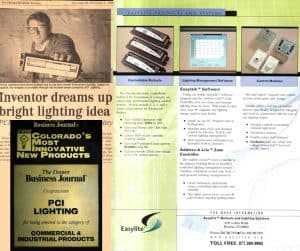
THE GOAL: REDUCE ELECTRICAL WASTE
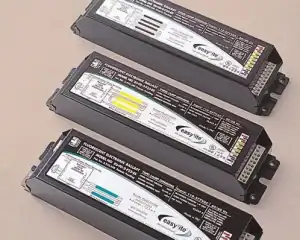
Pat’s work with EASYLITE fluorescent ballasts moved beyond experimentation into a commercial product that remained in use for approximately ten years.
One of the system’s innovations was particularly practical: power for lighting controls was available directly from within the ballast, eliminating the need for a separate external power source for devices such as light sensors.
That capability made much more sophisticated control of fluorescent lighting possible. Instead of simply turning large banks of lights on or off, lighting could be dimmed when full illumination wasn’t necessary.
Pat recalls two large commercial buildings—one 25 stories and the other 24 stories—saving more than $100,000 in a single year. For security lighting, for example, the entire building could remain illuminated with lamps operating at approximately 20% rather than 100%.
EASYLITE eventually disappeared following management problems with the company, but the technology had accomplished something important to Pat: it demonstrated that better engineering could significantly reduce unnecessary energy consumption.
2000s
NETWORKED CONTROL & BUILDING AUTOMATION
THE GOAL: IMPROVE PEOPLE’S COMFORT
Pat’s work in networked control and building automation expanded the idea of intelligent lighting into a larger question: could the systems within a building work together to make the environment more comfortable and easier to control?
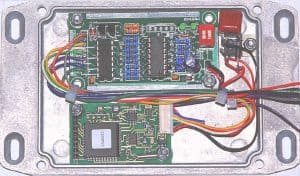
His work with Colorado vNet involved networked control technology that brought lighting and other building functions together into integrated systems. Rather than treating individual switches, lights and controls as isolated devices, the technology allowed them to communicate as part of a larger network.
For Pat, the purpose behind that technology was ultimately very practical: people’s comfort. Good engineering wasn’t simply about making increasingly sophisticated electronics. It was about making the spaces people lived and worked in respond better to the people using them.
That combination—complex technology serving a very ordinary human need—was another expression of the curiosity that ran throughout Pat’s career.
2010s-2020s
POWER & HORTICULTURAL LIGHTING
THE GOAL: IMPROVE HORTICULTURAL EFFICIENCY
Pat’s later work brought his experience with lighting and power electronics into an entirely different environment: horticultural lighting.
With GrowRay, Pat helped develop an LED luminaire system designed to address a deceptively simple problem. The physical structure supporting artificial grow lights can itself block valuable sunlight, creating shadows over the plants the system is intended to help.
Pat’s engineering work included the development of a new, efficient extrusion designed to reduce that shadowing and allow more natural sunlight to reach the plants. The goal was not simply to add more artificial light, but to make better use of the light already available.
The result reflected the same thinking that had followed Pat throughout his career: examine the entire system, identify where efficiency is being lost, and ask whether the design itself can be improved.
For Pat, the objective was straightforward: help plants use available light more efficiently and improve horticultural productivity.
U.S. Patents & Designs
The following U.S. patents and design patents reflect Pat’s work across aviation, lighting, power electronics, building automation and horticultural lighting. Several were developed in collaboration with other inventors.
1982 — U.S. Patent 4,342,912
Apparatus for Detecting Air Disturbances Created by Low Level Wind Shear
1984 — U.S. Patent 4,427,306
Radiometer Apparatus for Air Disturbance Detection
1988 — U.S. Patent 4,728,877
Method and Apparatus for Improving Electrochemical Processes
1990 — U.S. Patent 4,965,572
Method for Producing a Warning of the Existence of Low-Level Wind Shear and Aircraftborne System for Performing Same
1999 — U.S. Patent 5,933,340
Frequency Controller with Loosely Coupled Transformer Having a Shunt with a Gap and Method Therefor
2000 — U.S. Patent 6,072,282
Frequency Controlled Quick and Soft Start Gas Discharge Lamp Ballast and Method Therefor
2000 — U.S. Patent 6,088,249
Frequency Modulated Ballast with Loosely Coupled Transformer
2000 — U.S. Patent 6,094,017
Dimming Ballast and Drive Method for a Metal Halide Lamp Using a Frequency Controlled Loosely Coupled Transformer
2001 — U.S. Patent 6,181,066
Frequency Modulated Ballast with Loosely Coupled Transformer for Parallel Gas Discharge Lamp Control
2001 — U.S. Patent 6,188,177
Light Sensing Dimming Control System for Gas Discharge Lamps
2002 — U.S. Patent 6,400,103
Networkable Power Controller
2005 — U.S. Patent 6,927,546
Load Control System and Method
2007 — U.S. Patent 7,170,238
Control Systems and Methods
2007 — U.S. Patent 7,211,968
Lighting Control Systems and Methods
2008 — U.S. Patent 7,394,367
Keypad for Building Automation
2008 — U.S. Patent 7,417,384
Load Control System and Method
2008 — U.S. Patent 7,472,203
Global and Local Command Circuits for Network Devices
2016 — U.S. Design Patent D750,592
Radio
2016 — U.S. Design Patent D770,972
Charger Module
2021 — U.S. Patent 10,900,638
Shade and Shadow Minimizing Luminaire